On Monday, 7 September 2026, a presentation on the work and legacy of Ukrainian artist Viktor Tsymbal took place at the National Museum of the Holodomor-Genocide. The event marked the visit to Ukraine of Jorge Danylyszyn, head of the Prosvita Ukrainian Cultural Society in the Argentine Republic. It also featured Tsymbal’s painting The Year 1933, the first work of art to depict the Holodomor.


The event was organized by the Embassy of the Argentine Republic in Ukraine together with the National Museum of the Holodomor-Genocide, the Prosvita Ukrainian Cultural Society in Argentina, and the State Enterprise ‘Directorate-General for Rendering Services to Diplomatic Missions’.
Viktor Tsymbal was a distinguished Ukrainian painter, graphic artist, illustrator, engraver, scenographer, and designer whose long-lasting artistic and civic work in Argentina became an important chapter in the history of Ukrainian-Argentine cultural relations. He arrived in Argentina in late 1928 and lived there for more than three decades, producing a substantial part of his artistic output and becoming a prominent figure in the country’s cultural life.


His professional work had a broad international reach. In Argentina, he created advertising illustrations for leading publications and collaborated with a wide range of Argentine and international companies. His Argentine clients included Cervecería y Maltería Quilmes, Orbis, Compañía Argentina de Electricidad, Ferrocarriles del Estado Argentino, Alpargatas, Bodega Trapiche, Acindar, and Lutz Ferrando, while among the international companies operating in Argentina were General Motors, Ford, Shell, Kodak, General Electric, National City Bank of New York, Bank of Boston, Firestone, Coca-Cola, Swift, Opel, Nestlé, and others. His works appeared in numerous South American newspapers and magazines, and his career in graphic design and advertising helped establish him as a prominent figure in Argentina’s artistic and professional circles. For Tsymbal, Argentina was both a place of professional fulfilment and a setting where he continued to nurture Ukrainian cultural identity and to represent Ukraine through art.
The works inspired by his travels around Argentina, through Patagonia, the Andes, and Tierra del Fuego, hold a special place in Tsymbal’s legacy. Ukrainian themes were also integral to his art. It was in Argentina that he painted The Year 1933, a work dedicated to the Holodomor, which is now part of the permanent exhibition at the National Museum of the Holodomor-Genocide in Kyiv. In the post-war period, a significant part of his output consisted of anti-Stalinist cartoons challenging Soviet propaganda and the myth of a happy Soviet life, alongside works exploring Ukrainian history, culture, literature, mythology, and religious traditions.
Viktor Tsymbal’s contribution to community life was no less significant. He was actively involved in organizing Ukrainian community activities in Argentina, supported Ukrainian education and the press, created portraits of Ukrainian civic and political figures, and participated in the work of the Ukrainian House in Buenos Aires, assisted displaced Ukrainians and co-founded the Congress of Ukrainians in Argentina. His work combined artistic endeavour with active civic engagement and a contribution to the preservation of Ukrainian identity far from his homeland.
Today, Viktor Tsymbal’s legacy holds particular significance for strengthening cultural and people-to-people ties between Ukraine and Argentina. His life and career demonstrate how Ukrainian culture was not only preserved within Argentine society but also became part of a broader cultural dialogue between the two countries. Through his art, Tsymbal connected Ukrainian historical and cultural experience with the Argentine context, leaving a legacy that belongs to the shared history of Ukraine–Argentina cultural relations.
The preservation, research and promotion of Viktor Tsymbal’s creative legacy, in particular his original works, photographs, documents, posters and other materials safeguarded for decades by members of the Prosvita Ukrainian Cultural Society in the Argentine Republic, represent an important contribution to the cultivation of a shared historical memory. This heritage creates new opportunities for cultural diplomacy, academic cooperation, museum and exhibition projects, and further mutual understanding between the Ukrainian and Argentine peoples.
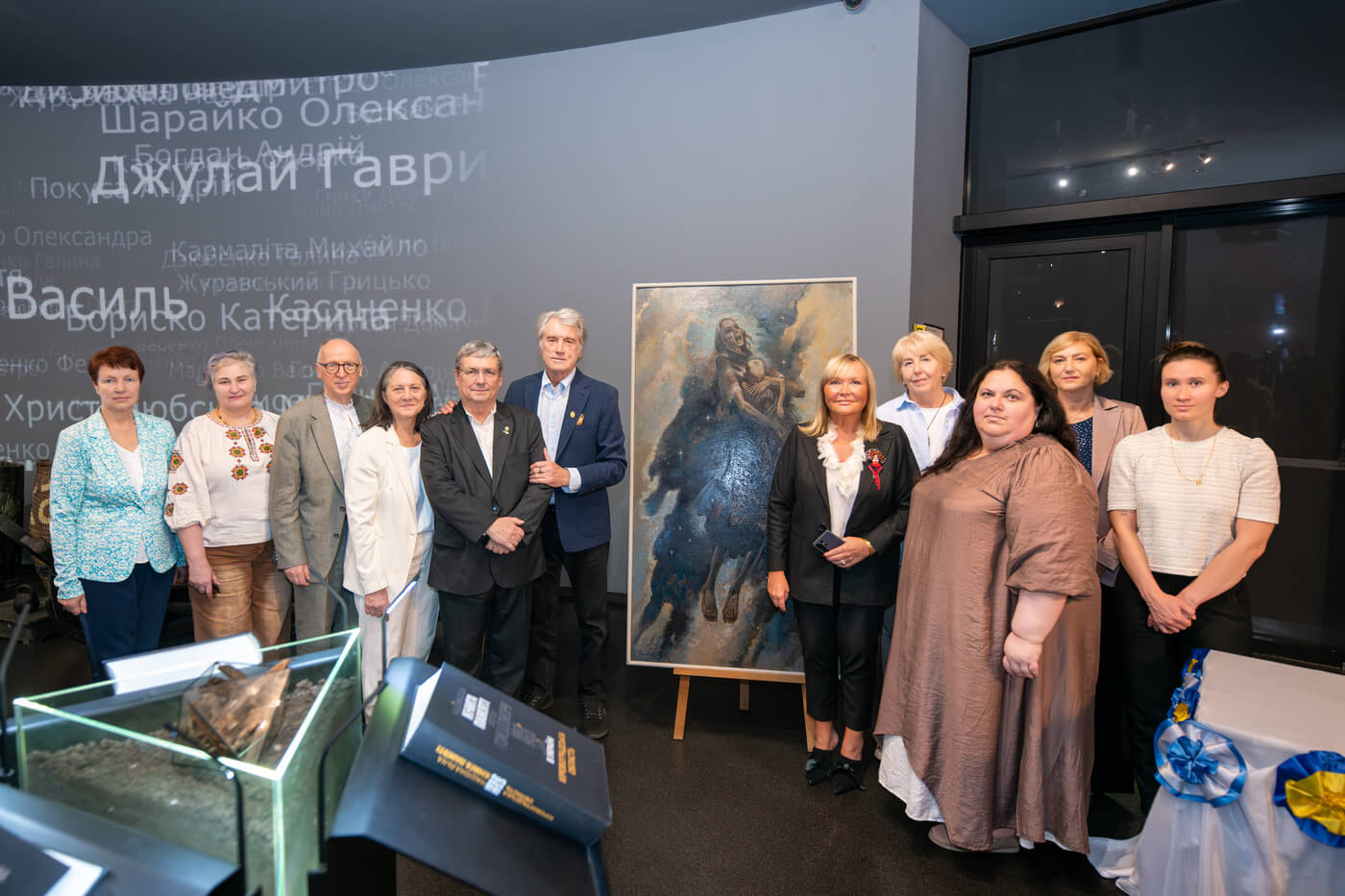
The event brought together the Ambassadors Extraordinary and Plenipotentiary of Brazil, Rafael de Mello Vidal, and Indonesia, Arief Muhammad Basalamah; the third President of Ukraine (2005–10), Viktor Yushchenko; representatives of the Ministry of Foreign Affairs of Ukraine, the Diplomatic Academy of Ukraine, and Taras Shevchenko National University of Kyiv; as well as public figures, scholars, and students.


The event opened with the laying of flowers at the Bitter Memory of Childhood monument to honour the victims of the Holodomor. The presentation was moderated by Ihor Ostash, director of the Hennadii Udovenko Diplomatic Academy of Ukraine, Ambassador Extraordinary and Plenipotentiary. In his opening remarks, Mr Ostash recalled the Ukrainian figures who, despite the risks, were among the first to bring the Holodomor to international attention. Among them was the artist Viktor Tsymbal.
In her welcome address, Elena Leticia Mikusinski, Ambassador Extraordinary and Plenipotentiary of the Argentine Republic to Ukraine, greeted the guests and introduced Jorge Danylyszyn and his wife, who have devoted decades of their lives to preserving Ukrainian identity, culture, and language in Argentina. She also emphasized the symbolic significance of the event, which highlighted the contributions of both Argentina and Ukraine to developing bilateral relations.
Lesia Hasydzhak, director-general of the National Museum of the Holodomor-Genocide, recounted the history of Viktor Tsymbal’s painting The Year 1933, its journey to Ukraine, and the museum’s subsequent research into the work. She also highlighted the importance of such artistic testimony in keeping the memory of the Holodomor alive.

Jorge Danylyszyn spoke about Viktor Tsymbal’s life and work in Argentina. His own family is closely connected with the history of the Ukrainian community movement in the country: his father, Miguel Danylyszyn, was a prominent figure in Argentina’s Ukrainian community, while his mother, Rosalia Danylyszyn, was actively involved in the Prosvita Ukrainian Cultural Society. Preserving the historical memory of Ukrainians in Argentina and raising awareness of Ukraine within Argentine society have been central to Jorge Danylyszyn’s work. He has initiated and actively helped implement a number of projects commemorating the victims of the Holodomor of 1932–33. For many years, Danylyszyn and the Prosvita Ukrainian Cultural Society have organized exhibitions, conferences, and cultural and educational events addressing Ukrainian history, the Holodomor, Ukrainian culture, and russia’s war against Ukraine. He launched the Prometeo project to organize and preserve library and archival materials accumulated over more than a century of Prosvita’s activities in Argentina. He also initiated the establishment of the Documentation Centre of the Ukrainian Community in Argentina within the Prosvita Ukrainian Cultural Society. Its purpose is to preserve the documentary heritage of Ukrainian immigration and the record of its contribution to Argentina’s history. Under his leadership, Prosvita also supports members of Ukrainian Antarctic expeditions travelling through Argentina.


In his presentation, Jorge Danylyszyn shared interesting and little-known details of Viktor Tsymbal’s life and discussed the artist’s contribution to Ukrainian cultural and community life and to keeping the memory of Ukraine alive: ‘Viktor Tsymbal took part in theatrical productions and had his own views on public affairs in Argentina. From the outset, in everything he did, he sought to bring about Ukrainian statehood.’ Mr Danylyszyn paid particular attention to the artist’s works on the Holodomor of 1932–33 and his community activities: helping Ukrainian migrants and deportees, participating in the establishment of a cultural centre, and seeking to convey the truth about Ukraine to Argentine society. He emphasized that Tsymbal’s art was not only creative expression but also a means of speaking about Ukraine’s tragedy and advocating Ukrainian statehood.
Viktor Yushchenko, the third President of Ukraine (2005–10), spoke about the importance of preserving the memory of the Holodomor and testimony to the Ukrainian tragedy. He stressed that this is a matter not only of understanding the past but also of affirming Ukrainian national identity and statehood: ‘We must remember the Holodomor so that we remain a nation and a sovereign, independent Ukrainian state. Every piece of testimony that recalls that period of our ancestors’ suffering, such as Viktor Tsymbal’s painting The Year 1933, gradually brings us back to a profound understanding that language, memory, culture, customs, traditions, and more are the essence of our nation.’
After the presentation, guests viewed Tsymbal’s painting and other exhibits in the museum. The event concluded with a group photograph.
Further information about the event, Viktor Tsymbal’s work and artistic legacy, and his life and activities in Argentina is available on the official online pages of the Embassy of Argentina in Ukraine.